
Search results
649 results
Search results

Autumn Magic is a compact, less spreading version of Black Chokeberry with a brilliant mixture of red-purple autumn foliage. Attractive white flower clusters appear in May, followed by clusters of blackish purple berries that persist through the winter. Clean, shiny dark green leaves turn purple-red in fall. Plant several in mass to amplify the colorful foliage and fruit display. Excellent for wet areas.

Carefree dwarf Mugo Pine will always stay within bounds! This handsome evergreen grows grows just 3-4 inches per year into a dense, uniform and compact mound of stiff, dark green needles. In spring showy creamy buds (candles) decorate the branch tips. Slowmound is the perfect choice for smaller spaces.


Introducing the Lemon Farmers Market Tee, crafted from soft, breathable fabric, this tee is your go-to choice whether you're strolling through the farmers market or lounging in the orchard. Featuring a delightful front and back peach design, our tee captures the essence of the vibrant zest lemons behold. Whether you're indulging in tangy lemons at the market or simply daydreaming of sun-kissed orchards, our Lemon Farmers Market Tee will add a touch of local charm that's sure to brighten your day. Perfect for gifting to the fruit lover, gardener, or orchard farmer in your life, this tee makes a delightful addition to birthdays, summer picnics, or any occasion that calls for a dash of fruity flair.
Material l 100% Cotton
Color l Butter
Fit l Unisex
Brand l Comfort Colors®
Care Instructions l Machine wash cold inside out, gentle cycle with like colors. Hang to dry.

The Lion’s Head Maple, ‘Shishigashira,’ is a refined Japanese maple prized for its dense, crinkled clusters of rich green leaves that ripple along upright branches. Slow and sculptural, it forms a compact, irregular mound—ideal as a living accent near an entry, patio, or courtyard. In autumn the foliage transforms into glowing shades of gold, orange, and crimson, a final flourish before winter. It grows best in partial shade with steady, moderate moisture and protection from harsh afternoon sun. Its modest size suits smaller gardens and large containers alike. Deer and rabbits typically leave it untouched, making it as practical as it is beautiful.

Staghorn Sumac is a bold, architectural native that earns its name from the velvety, antler-like branches that give the plant a distinctive year-round presence. The dramatic tropical-looking compound leaves — sometimes 18–24 inches long — turn an extraordinary range of scarlet, orange, and gold in autumn, making this one of the most spectacular fall color shrubs native to the Great Lakes region. Dense, upright cones of deep red velvet fruit persist through winter, drawing birds and providing an ornamental focal point when the landscape is otherwise bare. Exceptionally tough, drought tolerant once established, and spreading naturally into colonies, it’s ideal for naturalizing slopes, banks, and areas where erosion control with a native plant is the goal.

Opening Day Doublefile Viburnum lives up to its celebratory name with a spectacular spring display of pristine white lacecap flower clusters arranged in perfect horizontal rows that layer the tiered branches in a stunning seasonal show. Growing into a broad, graceful mound with a naturally horizontal branching habit, it delivers multiple seasons of interest — spring flowers, summer dark green foliage and early fruit, and brilliant red-burgundy fall color. Deer, rabbit, and disease resistant, and tolerant of Black Walnut root competition, it anchors the back of a border or serves as an impeccable large specimen shrub with understated year-round elegance.
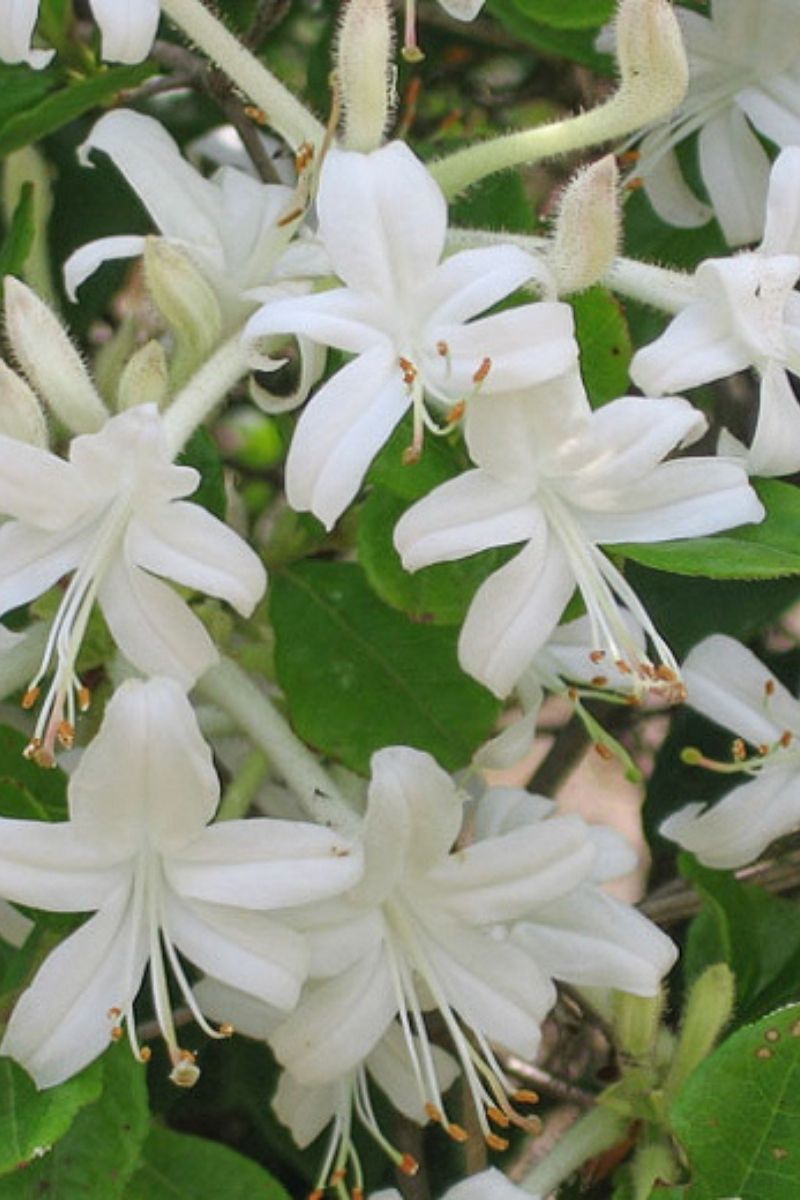
Prized for its strongly-scented flowers and beautiful fall foliage Swamp Azalea is a very appealing native to the swamps of the eastern United States, from Maine to Alabama, and westward to Texas. This bushy, medium-sized, deciduous shrub bears funnel-shaped, white flowers, often tinged pink, with long slender tubes. Held in small clusters of 3-12 flowers, they bloom profusely after the leaves emerge, in early summer and exude a strong clove-like perfume. The foliage of lustrous, elliptic, dark green leaves turns brilliant shades of yellow, orange and purple in fall, for a great colorful show. Exceptionally cold-hardy, this late season Azalea can withstand temperatures as low as to -20 °F (-29 °C). A wonderful landscape plant that deserves a place near a patio, deck or living area, where its delightful fragrance can be enjoyed.

Low Scape Snowfire® Aronia features showy panicles of white flowers with red anthers at the ends of the branches in mid spring. It features an abundance of magnificent navy blue berries from late summer to late fall, which fade to black over time. It has forest green foliage with olive green undersides. The glossy oval leaves turn an outstanding red in the fall.


Blackhaw Viburnum features showy creamy white flat-top flowers at the ends of the branches in mid spring. The royal blue fruits are held in abundance in spectacular clusters from early fall to late winter. It has dark green deciduous foliage. The pointy leaves turn an outstanding purple in the fall.


Winter King Hawthorn is blanketed in stunning clusters of white flowers held atop the branches in mid spring. The fruits are showy tomato-orange pomes carried in abundance from early fall to late winter. It has green deciduous foliage. The glossy pointy leaves turn an outstanding burgundy in the fall. The peeling silver bark adds an interesting dimension to the landscape.


Techny Arborvitae is a dwarf conifer which is primarily valued in the landscape for its distinctively pyramidal habit of growth. It has dark green evergreen foliage. The scale-like sprays of foliage remain dark green throughout the winter.

An uplifting rose bearing unusual open cupped flowers of soft yellow, paling to cream. The scallop-shaped, incurved petals are loosely yet generously assembled around a central boss of golden stamens, creating a soft, airy appearance. There is a spectacular first flush of blooms, which are borne in well-spaced sprays and displayed proudly against the mid-green, semi-glossy foliage. Forms a healthy, medium-sized upright bush with a light myrrh fragrance, whose hips must be removed to encourage repeat flowering. Named in honour of Aneurin (Nye) Bevan, founder of Britain’s National Health Service and in recognition of the NHS, its people and associated organisations and charities.

Weigela Tower of Flowers™ Apple Blossom is a deciduous flowering shrub offering 3 seasons of interest. Apple Blossom has an unusual, neat habit with erect branches. Large shell-pink blooms are borne in clusters along the entire stem, creating a column of flowers in late spring/early summer, set against oval leaves, which emerge bronzed but mature to dark green. Nectar-rich, the long-lasting tubular flowers attract bees, butterflies, and hummingbirds.

Bud’s Yellow Dogwood is a four-season shrub with something beautiful to offer in every month of the year, from delicate white spring blooms to a spectacular show of fiery autumn foliage. Growing 15–20 feet with a graceful vase-shaped habit, it makes a striking specimen in partial shade. Summer brings full, healthy green foliage that erupts into a tapestry of orange, burgundy, gold, and copper-bronze tones as the season turns. Birds are drawn to the small fruit that follows the spring flowers, adding wildlife interest throughout summer and fall. Its bright yellow stems glow all winter long after the leaves drop, making it genuinely ornamental even in the coldest months. It’s cold-hardy and performs reliably year after year without demanding much in return. Plant it where you can appreciate the full sweep of the seasons — this dogwood never disappoints.

An arching, sprawling evergreen shrub with very pointy needles streaked with interesting silvery blue lines and abundant showy powdery blue berries; extremely adaptable to poor soils and dry locations, very hardy Blueberry Delight Juniper is primarily grown for its highly ornamental fruit. It features an abundance of magnificent blue berries from late spring to late winter. It has attractive powder blue foliage with silver stripes. The needles are highly ornamental and turn coppery-bronze in fall. The flowers are not ornamentally significant. Blueberry Delight Juniper is a multi-stemmed evergreen shrub with a ground-hugging habit of growth. It lends an extremely fine and delicate texture to the landscape composition which can make it a great accent feature on this basis alone. This is a relatively low maintenance shrub, and is best pruned in late winter once the threat of extreme cold has passed. It has no significant negative characteristics. Blueberry Delight Juniper is recommended for the following landscape applications; Mass Planting General Garden Use Groundcover This shrub should only be grown in full sunlight. It is very adaptable to both dry and moist growing conditions, but will not tolerate any standing water. It is considered to be drought-tolerant, and thus makes an ideal choice for xeriscaping or the moisture-conserving landscape. It is not particular as to soil type or pH. It is highly tolerant of urban pollution and will even thrive in inner city environments. This is a selection of a native North American species.


Compact Inkberry Holly has dark green evergreen foliage on a plant with a round habit of growth. The glossy narrow leaves remain dark green throughout the winter. It produces black berries from mid-fall to late winter.


An unusual garden shrub in that it features highly attractive flat-topped flowers in combinations of red, pink and white all on the same plant, held above the foliage in early summer; upright and mounded, makes an ideal color accent or garden detail shrub

Cecile Brunner Rose features showy clusters of lightly-scented pink flowers along the branches from mid spring to early fall. The flowers are excellent for cutting. It has dark green deciduous foliage which emerges red in spring. The glossy oval compound leaves do not develop any appreciable fall color.