
Shrubs (for programming)
781 products
Sort by:
781 products
781 products


It's officially spring when the Forsythia blooms! Gold Tide is a dwarf, spreading Forsythia twice as wide as tall with a profusion of light yellow flowers on bare branches in April. Dense, dark green, trouble-free leaves may acquire burgundy and yellow tones in fall. Creates a stunning floral display when planted in groups. They can even provide cut flowers! Also makes a nice low, natural hedge. Deer don't care for it.


Viburnum carlesii commonly called Koreanspice viburnum is a slow-growing, upright, rounded, deciduous shrub which typically matures to 4-5' tall but may reach a height of 8' in optimum growing conditions. Red buds open in late March/early April to pink-changing-to-white flowers which are arranged in snowball-like clusters (hemispherical cymes) to 3" across. Flowers are very fragrant. Flowers give way to non-showy, berry-like drupes which mature to blue-black in late summer. Broad ovate, serrate, dark green leaves (to 4" long) are infrequently flushed with copper. Foliage usually turns dull red in fall, but may sometimes display attractive shades of wine-red to burgundy.
Mature Height: 4’ to 6’
Mature Width: 4’ to 7’
Sun: Full sun to Part shade
Soil: Well-drained
Hardiness Zone: 4 - 7

Pinky Promise™ Snowberry is primarily grown for its highly ornamental fruit. It features an abundance of magnificent pink berries with white hints from late summer to early fall. It features subtle white bell-shaped flowers with pink overtones along the branches in early summer. It has bluish-green foliage with grayish green undersides. The oval leaves do not develop any appreciable fall color.
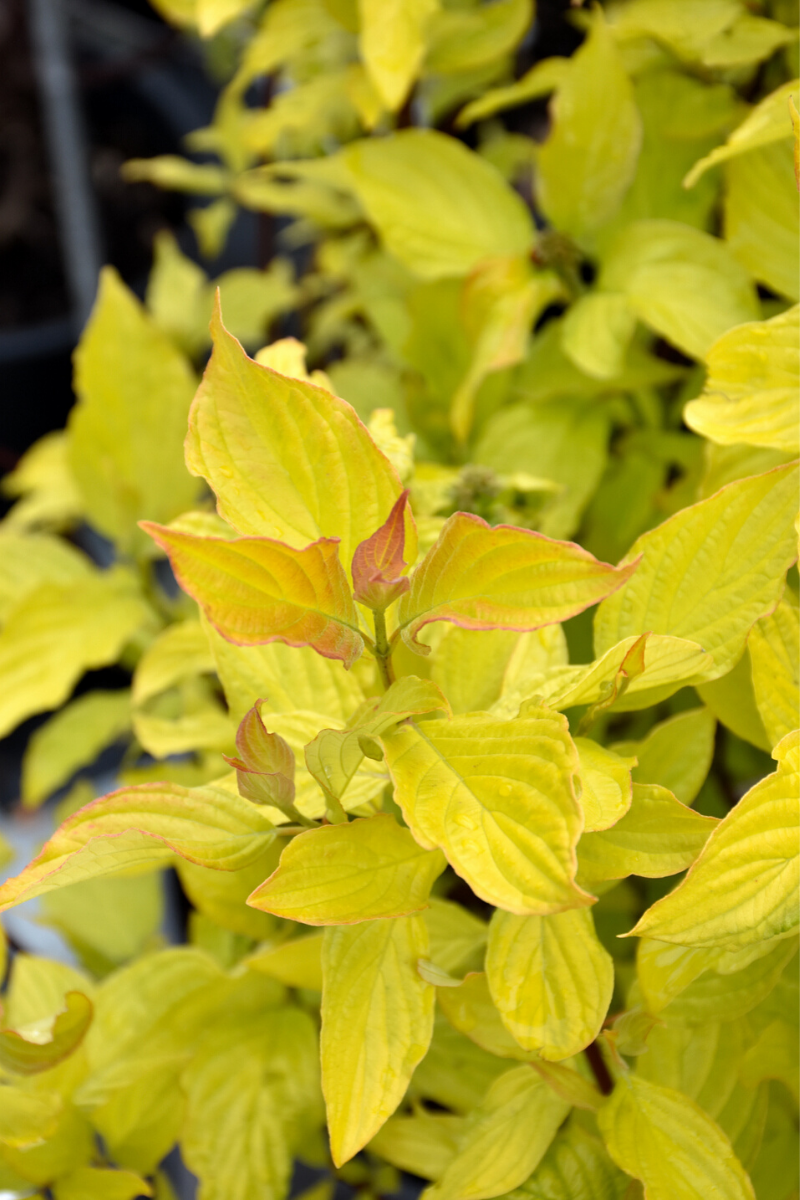
Neon Burst Dogwood earns its name with a dazzling season-long foliage display that brings electric chartreuse color to the garden even when the shrub isn’t in bloom. It’s a true multi-season performer with white spring flowers, brilliant fall color in shades of gold, red, and deep purple, and showy scarlet stems that command attention throughout winter when the garden needs it most. Growing 15–20 feet with a graceful vase-shaped form, it makes a striking specimen in partial shade with moderate water needs. Butterflies are drawn to the spring flowers, and birds appreciate the small fruit that follows. Cold-hardy and adaptable, it’s a straightforward, rewarding shrub for anyone seeking year-round interest. Give it a prominent spot where all four seasons can be fully appreciated.

Mint green variegated leaves with creamy white margins become tinged with pink or red in fall. Compact and densely branched with chartreuse stems that add character to the winter landscape. A wonderful shrub for all seasons! The best stem color is produced in full sun but tolerates partial shade. Deciduous

An exceptional tall accent shrub featuring upright panicles of deliciously fragrant bluish-purple flowers in early spring on an upright growing shrub, memorable in bloom; needs full sun and well-drained soil, limited suckering, good disease resistance.

Unusual and striking network of white veins on dark green foliage make this shrub a rarity; dazzling gold flowers smother the branches in early spring ahead of the leaves

Ludwig Spaeth Lilac features showy panicles of fragrant purple flowers rising above the foliage in mid spring, which emerge from distinctive violet flower buds. The flowers are excellent for cutting. It has bluish-green deciduous foliage. The heart-shaped leaves do not develop any appreciable fall color.


A beautiful, adaptable and hardy shrub offering four-seasons of interest. Vibrant red twigs are stunning in the winter garden. Spring flowers yield small ornamental fruit that is attractive to birds. Colorful fall foliage. Spreading habit is helpful in controlling erosion. Tolerates clay, wet soil. Deciduous.
Mature Height: 6’ to 9’
Mature Width: 8’ to 12’
Sunlight: Full sun to part shade
Soil: Rich, consistently moist soil
Hardiness Zone: 3 - 8


Golden Lights Azalea is one of the hardiest selections in the renowned Northern Lights series, bred to withstand the most brutal Michigan cold with flower buds still intact come spring. In mid spring, a profusion of rich golden-yellow fragrant tubular flowers smothers the branches before the leaves emerge, lighting up partially shaded spots with warm color at a time when the garden is just waking up. The compact, neat mounding form pairs beautifully with shade-loving companions and requires little care once established in acidic, well-drained soil. Deer and rabbit resistant, it’s a reliable performer for Great Lakes gardeners seeking azalea beauty without the winterkill anxiety.


Rockspray Cotoneaster is primarily valued in the garden for its cascading habit of growth. It features tiny clusters of pink flowers along the branches in mid spring. It has dark green deciduous foliage. The tiny glossy round leaves turn an outstanding brick red in the fall.


An unusual garden shrub in that it features highly attractive flat-topped flowers in combinations of red, pink and white all on the same plant, held above the foliage in early summer; upright and mounded, makes an ideal color accent or garden detail shrub

This variety features dark burgundy emerging foliage that transitions to a rich green; breakthrough red flower color transitions to pink in early summer; has a dense mounded habit perfect for landscapes

Looking for something a little different? You've found it in 'Aphrodite' calycanthus! Covered in big, glossy leaves, this shrub explodes with enormous cupped flowers that look a bit like a deep red magnolia. They start in early summer and continue through the season - in cooler areas, like our West Michigan trial gardne, they bloom all summer long. This is a quite large shrub that needs plenty of space to look its best, but if you have the room for it, there are few better ways to use it!
'Aphrodite' is a hybrid between our native Calycanthus and the Asian species, xSinocalycanthus. You're probably wondering if it's fragrant, and the answer is - it depends. The scent varies based on the age of the bloom, the time of day, and the flower itself. Some people say they smell like pineapple, others apples, others bubblegum, and some get no scent at all. Even if you never sense a whiff off this plant, its fabulous flowers are more than enough reward.
Top reasons to grow Aphrodite calycanthus:

A new and lovely hardy shrub, Viburnum plicatum 'Kilimanjaro' has flat clusters of pure white flowers in early summer and a striking, upright, pyramidal shape. The attractive flowers are followed by masses of bright pinkish/red berries in late summer/early autumn.
'The leaves are dark green in spring and summer, turning pretty shades of dark red before falling in autumn.
Viburnum plicatum 'Kilimanjaro is a handsome specimen shrub with a distinctive, narrow habit. Flowers best in a sunny position.


Bailey Compact Highbush Cranberry features showy white lacecap flowers held atop the branches in late spring. It features an abundance of magnificent scarlet berries from late summer to late winter. It has dark green deciduous foliage which emerges brick red in spring. The serrated lobed leaves turn an outstanding orange in the fall. The smooth gray bark and gold branches add an interesting dimension to the landscape.


Phantom Hydrangea features bold conical white flowers at the ends of the branches from mid summer to late fall. The flowers are excellent for cutting. It has green deciduous foliage. The pointy leaves do not develop any appreciable fall color.

Fiber Optics ® is a distinct improvement over the coarser Cephalanthus occidentalis that grows twice the size of this compact selection. Buttonbush is quite happy in moist conditions, tolerating flooding and wet spring soil. As such it is often used in wetland restoration work, along streams and pond banks. It’s also a great plant for low areas in the landscape that don’t dry out until late in the season. The spherical flowers are fragrant, creamy white, and many species of waterfowl eat the seed.

An early season blueberry with rave reviews! This vigorous Northern-Southern cross produces a heavy crop of sweet, juicy, berries early in the blueberry season — and, in mild areas, a lighter second crop develops later that same year. Yields up to 15 pounds per plant. Developed in 1999, introduced in 2010. Cold-hardy. First crop ripens in late May to early June. Second crop ripens in August. Self-pollinating.
| Bloom Color | White |
| Bloom Time | Late |
| Fruit Color | Blue |
| Fruit Size | Large |
| Pollination | Self-Pollinating |
| Ripens/Harvest | First Crop Late May Or Early June, Second Crop August |
| Shade/Sun | Partial Shade - Full Sun |
| Soil Composition | Loamy |
| Soil Moisture | Well Drained |
| Soil pH Level | 4.5 - 5.5 |
| Taste | Sweet, Juicy |
| Texture | Firm |
| Years to Bear | 2 - 3 |
| Zone Range | 4 - 8 |
Plants are constantly growing, ever-changing, and therefore unique. The plant you receive may vary from the photo, but rest assured, it holds the same glorious potential!

Red Sensation Bartlett Pear is a small tree that is typically grown for its edible qualities. It produces red oblong pears (which are botanically known as 'pomes') with white flesh which are usually ready for picking in early fall. The pears have a sweet taste and a juicy texture.
The pears are most often used in the following ways:
- Fresh Eating
- Cooking
- Baking
- Juice-Making
- Canning

Showing 476/781
Next
Have questions?
Shopping Consultation
Now you can book an in-person appointment with one of our product experts who'll help you find everything you need prefect for your home and garden, including outdoor and indoor plants, garden essentials, furniture, home décor, pet food and accessories, apparel, bath + body, and much more.
You Recently Browsed ...


